

Checklists & templates
Executive Digital Footprint Checklist
Executive digital footprint is not just a privacy issue. It is business attack context.
Most exposed details look harmless in isolation. The risk grows when someone can connect an executive's authority, public profile, director records, broker contact data, breach history, household links, and payment influence.
Published
Quick answer
An executive digital footprint includes everything publicly visible about a senior leader — Companies House filings, data broker profiles, personal emails in breach databases, speaking bios, and household links. The risk is not any single record. It is the picture an attacker can build when those records combine to make impersonation believable.
Want this checked privately?
Want this checked privately?
Hushfolk can review executive exposure, document priority findings, and provide a reduction plan without requiring personal data on the first call.
How exposure becomes risk
How executive exposure becomes a believable pretext
A single exposed detail is rarely the issue. The risk grows when multiple signals connect around a person with authority.
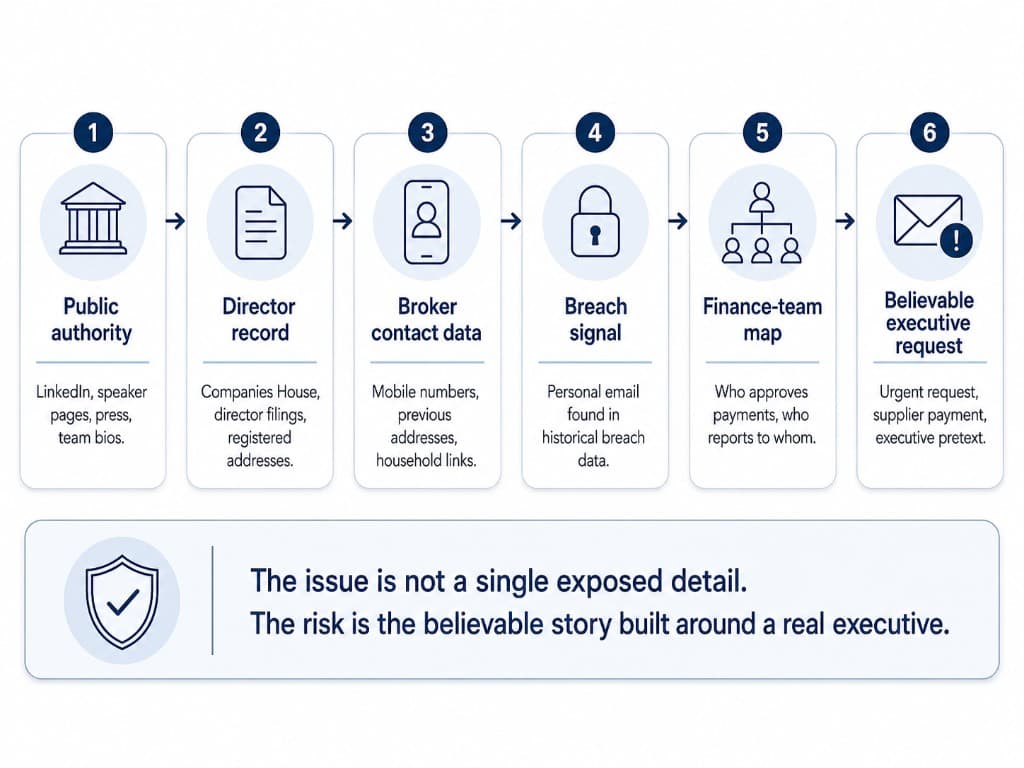
An executive's public profile may be normal. A director filing may be expected. A broker record may be common. An old breach may feel historical. But when those signals connect to authority, payment influence, household context, or internal reporting lines, the exposure becomes more useful to someone trying to impersonate, pressure, or manipulate.
The issue is not a single exposed detail. The risk is the believable story built around a real executive.
Where to start
The five executive exposure surfaces to review first
Do not start by searching randomly. Start with the surfaces most likely to create believable context around an executive.
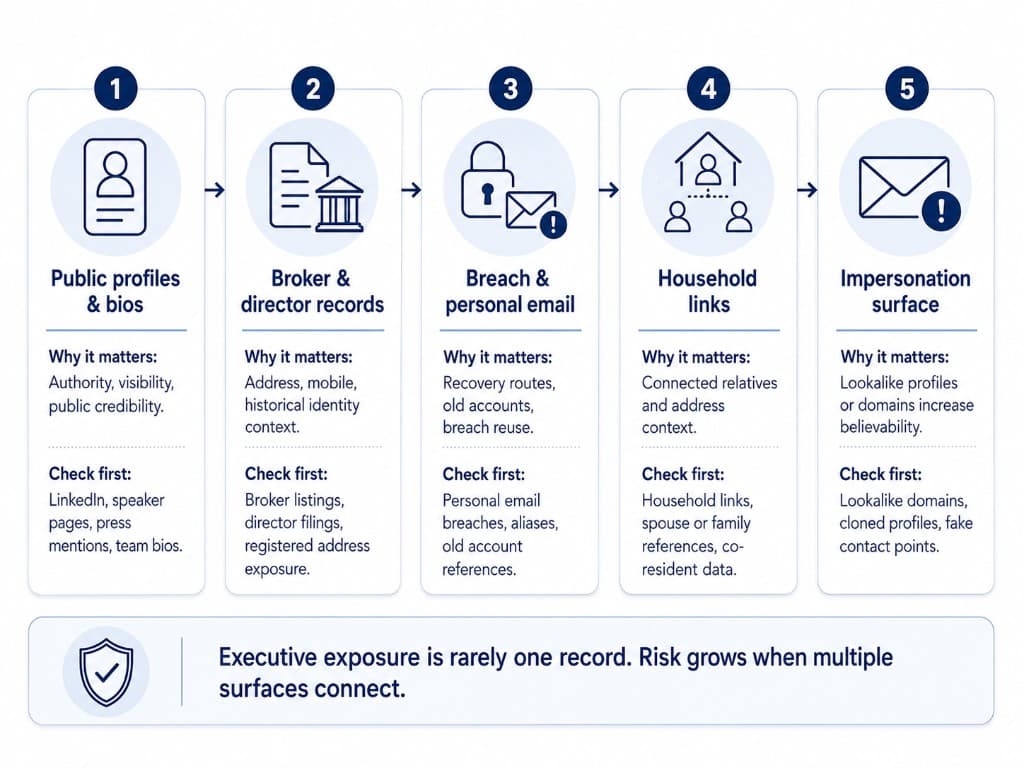
Public profiles & bios
Why it matters
Authority, visibility, public credibility.
Check first
LinkedIn, speaker pages, press mentions, interviews, team bios.
Broker & director records
Why it matters
Address exposure, mobile numbers, historical identity context, official filings.
Check first
Broker listings, Companies House or director records, registered address exposure.
Breach & personal email
Why it matters
Old credentials, account recovery routes, password reuse clues, aliases.
Check first
Personal email exposure, historical breach data, old account references.
Household links
Why it matters
Spouse, relatives, shared addresses, family context, expanded targeting surface.
Check first
Household-linked records, family references, co-resident data, address connections.
Impersonation surface
Why it matters
Lookalike profiles, fake domains, cloned contact points, believable outreach.
Check first
Lookalike domains, copycat profiles, supplier-facing pretexts, fake contact routes.
In practice
What counts as an executive digital footprint
What counts as an executive digital footprint?
Most people think of LinkedIn when they hear digital footprint. That is one part of it. For senior leaders, the picture is wider.
Companies House lists director home addresses. Old in many cases — but still searchable. Data broker sites hold addresses, mobile numbers, and household connections pulled from electoral roll data, property transactions, and court records. A CEO who moved four years ago may still have their old address sitting on two dozen broker profiles.
Then there is breach data. Personal emails appear in leaked databases more often than most executives realise. A Gmail address used to register for a conference. An old Apple ID. An account from a previous employer. These surface in breach databases alongside passwords, phone numbers, and recovery email addresses.
Speaking bios add another layer. They often include a personal mobile, an email, or a headshot that matches the face associated with financial accounts. Press coverage links names to decisions, announcements, and sometimes payment context. And if anyone in the executive's household has public exposure too — a partner's name, a shared address, a social profile — that builds the picture further.
None of this is a hack. It is public data collected by systems that run quietly in the background. That is what makes it useful to someone who wants to impersonate your CEO.
Why leadership gets targeted first
The CEO request to finance is one of the oldest social engineering routes there is. It does not start with a sophisticated attack. It starts with enough context to make a message feel real.
Authority and urgency together are a powerful combination. When a message appears to come from a CEO or CFO, people respond quickly. That is not a failure of training — it is how most organisations are designed to work. The attacker's job is to borrow that authority, and public data helps them do it convincingly.
Payment approval context makes executives especially valuable targets. Senior leaders are often named in supplier agreements, banking mandates, and payment authorisation trails. An attacker who can reference the right bank, the right supplier, and the right approval context is not guessing. They are using information that took less than an hour to collect.
There is also a scale problem. A finance team member has exposure. An executive has exposure plus public authority context plus press coverage plus a personal profile that most attackers can access without a subscription. That combination does not need a zero-day exploit to be dangerous.
Self-assessment
Run a 2-minute executive exposure readiness check
This is not a scan. It does not search for executive data and does not require names, emails, addresses, or staff records. It helps you understand whether your company has a basic process for reviewing executive-linked exposure.
No process yet?
If you cannot answer most of these, you do not have an executive exposure process yet.
That does not mean something has gone wrong. It means attackers may have more executive context than your company is currently tracking.
Worked example
What a connected executive exposure record can look like
The goal is not to panic over a single public detail. The goal is to identify when multiple public signals connect around a real executive and create business risk.
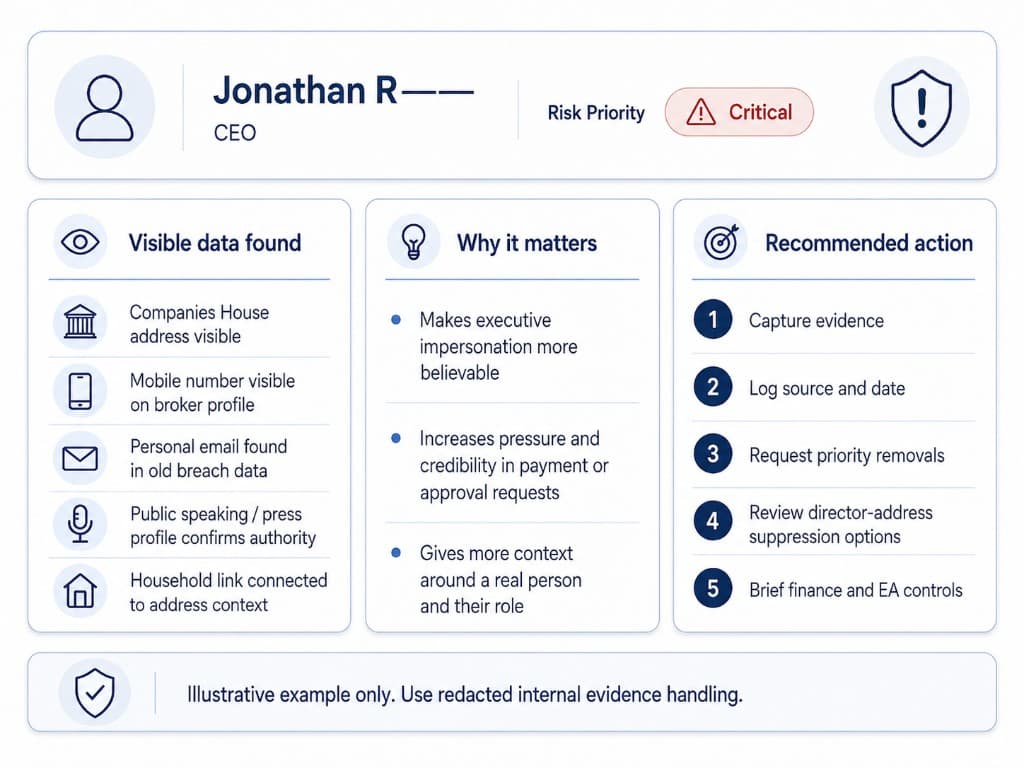
Use fictional or redacted examples only. Avoid circulating unnecessary executive personal data when documenting exposure internally. This record exists to help security teams understand what connected exposure looks like — not as a template for sharing real leadership information.
How pretexts are built
How a believable executive request is built
A credible pretext does not always require sophisticated compromise. Sometimes it is built from public authority, contact routes, reporting lines, and timing.
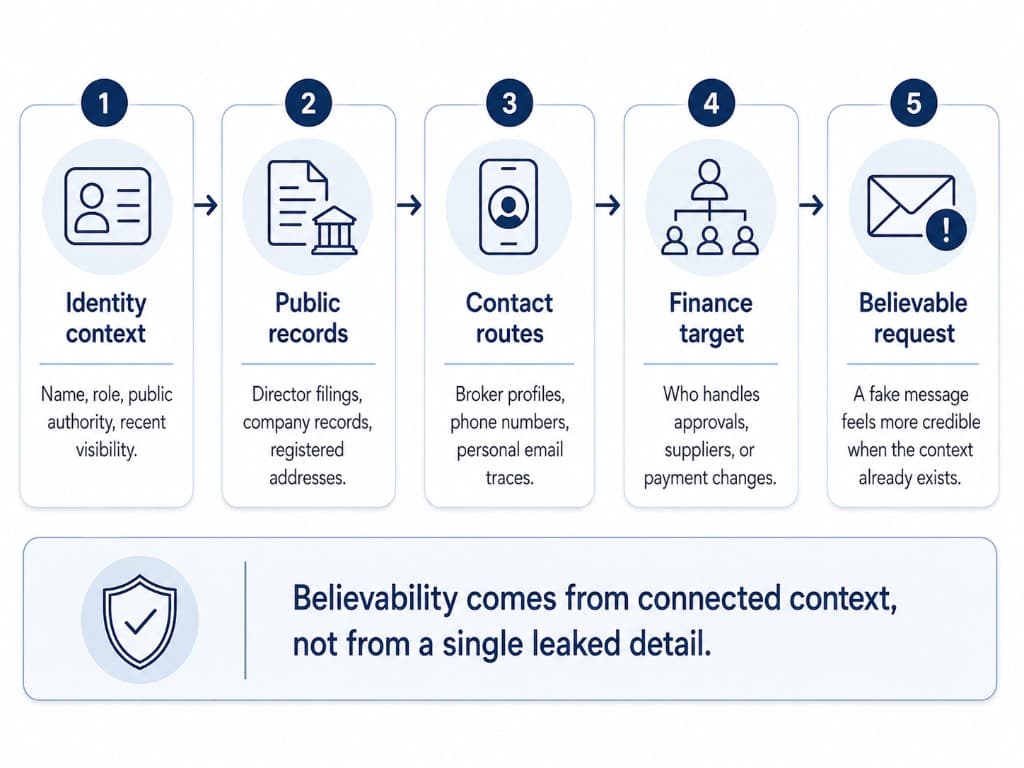
Someone does not need every detail to create pressure. A small amount of public context can make an urgent message feel plausible, especially if the recipient already recognises the executive's role, supplier relationship, or approval authority.
The impersonation path attackers actually use
Here is how a realistic executive impersonation pretext gets built.
Step one: LinkedIn. Role, employer, direct reports, recent announcements. Three minutes.
Step two: A data broker search on the full name and city. Home address, mobile number, spouse's name, previous addresses. On a typical broker site, this takes about twelve minutes. No subscription required.
Step three: A breach database check on any personal email addresses found. Password hashes, recovery addresses, linked accounts. Often free.
Step four: Companies House. Director filing with service address. Sometimes that is still a home address if the director never updated it after registration.
Step five: A LinkedIn search for the finance director or payments team — whoever the attacker wants to target. Now they have both sides of the social engineering chain.
Total time: under an hour. Total cost: close to zero.
The payment request that follows is not sophisticated. It is a well-framed use of public data. The target has no reason to doubt it because the context feels right — the right name, the right authority, the right amount of familiarity.
The 15-minute leadership exposure check
This is a process for security teams, operations teams, or board-level administrators. It does not require collecting or sharing executive personal data — you are checking what is already publicly visible.
Start with the executive's full name in quotes on a standard search engine. Note what is visible on the first two pages: speaking bios, press coverage, company profiles, event appearances.
Run the name through two or three well-known data broker sites. Note whether an address, mobile number, or household connection is visible without a subscription.
Check Companies House for director filings. Look specifically at the service address — is it a home address?
Run any known personal email addresses through a breach checking service. Note which breaches are listed and what data types were exposed.
Search for lookalike domains registered in the executive's name or a variation of the company name. These sometimes appear before an impersonation email campaign starts.
Document what you find for each executive reviewed. You are not trying to clear all exposure in one session. You are building a clear picture of where the highest-risk records sit.
Private review
Could someone build this around your CEO or CFO?
A private review shows whether executive authority, contact data, public records, and finance context are connecting in ways that deserve action.
Risk priority
What should be prioritised first?
Not every executive exposure carries the same risk. Prioritise people where authority and exposure depth overlap.
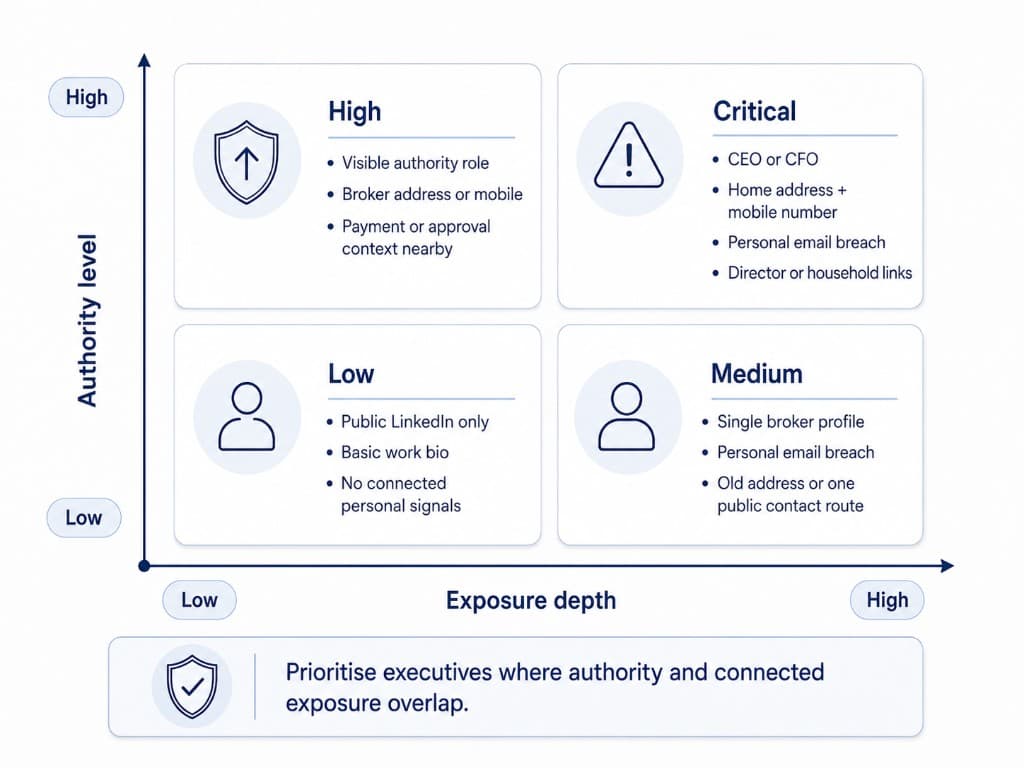
- LowPublic LinkedIn profile or work bio with no connected personal signals.
- MediumSingle broker profile, old address, or personal email breach with limited connection to authority.
- HighVisible executive authority combined with mobile number, broker address, supplier context, or approval influence.
- CriticalCEO, CFO, founder, or director exposure connected to home address, mobile number, personal email breach, household links, or filing records.
Documentation
What a board-ready exposure summary should show
A serious process needs more than screenshots. It needs source notes, evidence dates, risk level, owner, action taken, and a recheck schedule.
| Executive group | Exposure surface | Risk | Action | Owner | Recheck |
|---|---|---|---|---|---|
| CEO / founder | Home address + broker profile | Critical | Removal requested | Security | 30 days |
| CFO / finance leader | Personal email breach | High | Monitoring + control review | IT / Finance | 30 days |
| Director / board member | Director filing address | High | Suppression route reviewed | Ops | 60 days |
| Public-facing executive | Press profile + contact route | Medium | Logged and monitored | Comms | Quarterly |
The purpose is to give security, operations, finance, and leadership a shared view of what was found, what was actioned, and what needs reviewing.
Finding exposure is only part of the process. Without documentation, findings disappear. Records that were removed come back. New exposures get missed.
An executive exposure log should capture: the person's name and role, the source where exposure was found, what specific data was visible, the risk level assigned, the action taken, the date of that action, who owns the follow-up, and the next recheck date.
A shared spreadsheet managed by one person in the security or operations team is enough for most organisations. The point is that anyone on the team can open it and see what has been done — and what has not.
The recheck date matters more than most teams expect. Broker sites re-aggregate data from public sources continuously. A record removed today may reappear in six months. Scheduling a quarterly recheck for each executive in scope prevents that from becoming a blind spot.
What good looks like
What good looks like: quarterly executive exposure review
Executive exposure is not a one-off cleanup. Roles change, records return, new breach data appears, and public visibility shifts. A quarterly review gives the business a lightweight rhythm without becoming a burden.
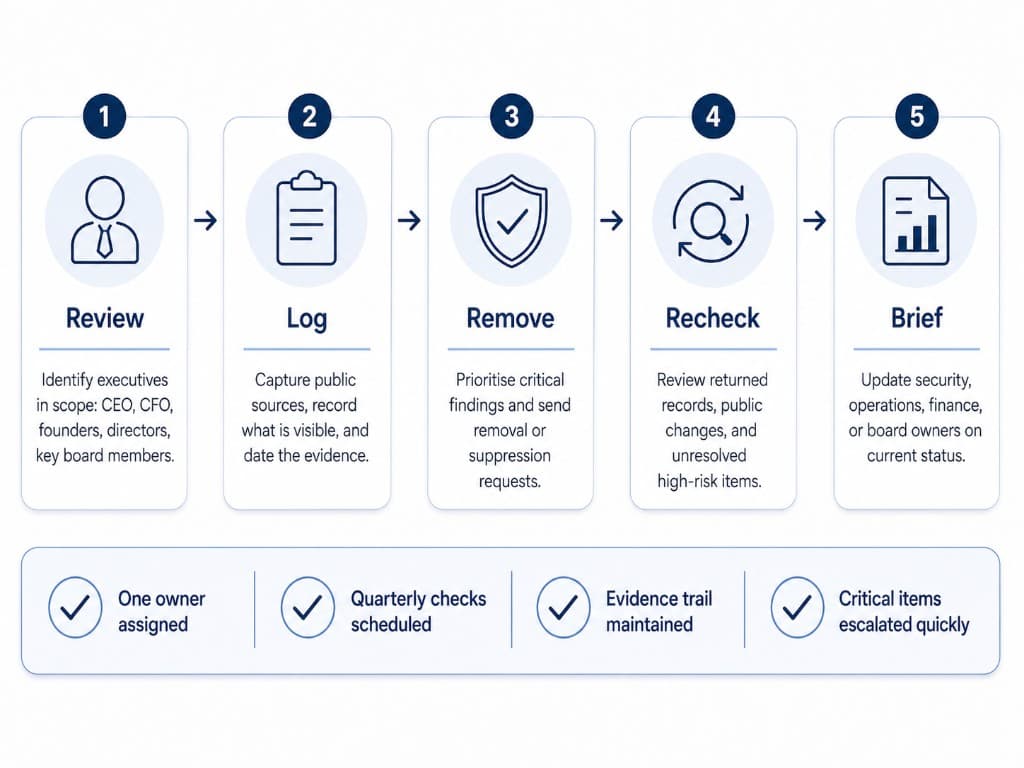
- 1Review executives in scope — CEO, CFO, founders, directors, public-facing leaders.
- 2Log visible sources and evidence dates for each finding.
- 3Remove or suppress priority findings where possible.
- 4Recheck returned or unresolved records from the previous cycle.
- 5Brief security, finance, operations, or board owners on current status.
The most common mistake is treating executive exposure as a project — something reviewed once and then closed. The data does not work that way.
Broker sites scrape and re-aggregate constantly. New breach data enters databases on a rolling basis. Roles change. Home addresses change. Family connections shift. Press coverage accumulates.
A quarterly review cycle for high-risk executives keeps the process manageable without becoming a burden. It does not need to be comprehensive every time. A one-hour review covering the top findings from last quarter — checking whether they have changed, whether removal requests have been actioned, and whether any new exposure has appeared — is enough to stay ahead of the most obvious risks.
The trigger for an off-cycle check is a role change, a significant press event, a house move, or any sign that a specific executive has attracted targeted attention. Those events reset the risk picture faster than a calendar reminder will catch.
Checklist
Quick-start checklist
Use this as your starting point for each executive in scope. The full 20-point worksheet is available below.
- Companies House director filing reviewed — service address confirmed as business address, not home
- Data broker profiles checked for address, mobile, and household connections visible without a subscription
- Personal email addresses checked against breach databases for each executive in scope
- Speaking bios and event profiles reviewed for any personal contact details listed publicly
- Household or family links in public records noted and assessed for impersonation risk
- Lookalike or impersonation domains checked for executive names and company name variants
- LinkedIn and public profiles reviewed for payment approval or authority context visible to strangers
- Removal requests logged with dates, route used, and evidence of outcome
- Owner and recheck date assigned for each finding
- Quarterly review scheduled for all executives in scope
Free download
Get the full 20-point Executive Digital Footprint Worksheet
Prioritisation framework, redacted record template, and a quarterly board-ready review schedule — structured for security and operations teams.
Request the worksheetFrequently asked questions
What is the difference between executive exposure and general employee exposure?
The scale and the public context. Most employees have some exposure — a work email, a LinkedIn profile, maybe a broker record. Executives have all of that plus public authority context: press coverage, Companies House filings, speaking bios, financial announcements, and a public role that makes impersonation attempts far more believable. The combination of visibility and authority is what makes leadership exposure a distinct category worth reviewing separately.
Is it appropriate for organisations to review publicly available data about their own executives?
Yes, with a clear internal policy in place. The data being reviewed is already publicly accessible — the review is about understanding what is visible, not collecting new personal data. Most security teams treat this as a standard part of executive protection. The ICO's guidance on legitimate interests supports proportionate internal security reviews of publicly available information where there is a clear business security purpose.
How often should C-suite exposure be rechecked?
Quarterly is the standard recommendation for active executives. Triggers for an off-cycle check include a role change, a significant press event, a home address change, or any indication that a specific executive has attracted targeted attention. Directors who have stepped back from active roles can be moved to a bi-annual or annual recheck schedule without losing meaningful coverage.
What should be prioritised first for a CEO versus a board NED?
For an active CEO or CFO, the highest priority is anything that combines home contact details with visible payment authority context — broker profiles with address and mobile, personal email breaches, and any Companies House service address exposure. For a board NED with a lower public profile, the priority is usually broker records and any Companies House filings that list a personal address rather than a registered business address.
Private executive exposure audit
Turn this checklist into a reviewed executive exposure report
For companies that want this handled properly, Hushfolk can review executive, founder, director, finance-leadership, and board-level exposure, then provide documented findings and a reduction plan.